

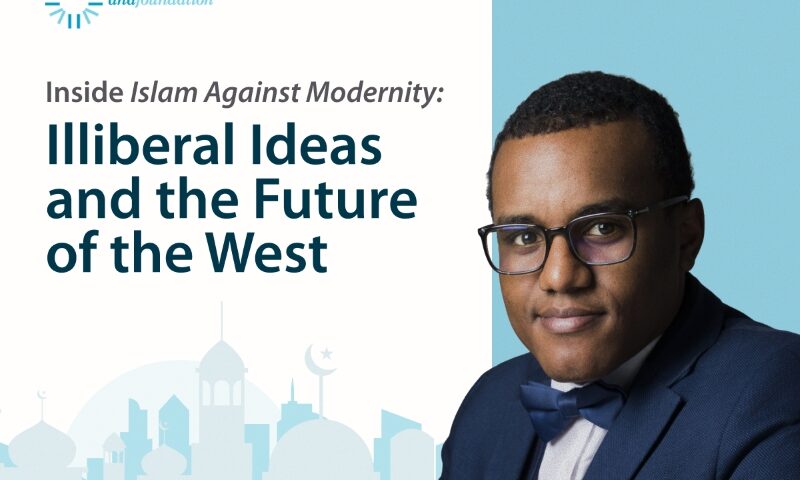
Stéphane Azihari, a columnist for Figaro Magazine and France Info TV, is one of France’s rising classical‑liberal voices.
In his latest book, Islam Against Modernity, Azihari—who comes from a Comorian Muslim family from the islands off East Africa—offers a bold and deeply researched critique of today’s Muslim world. Drawing on foundational texts and geopolitical analysis, he argues that many Muslims have distanced themselves from Islam’s intellectual heritage of ancient civilizations and developed a strict religious moral system that controls their societies and individual lives.
The French magazine Tribune Juive, a Jewish cultural and opinion outlet, even described Azihari as a “Voltaire of our time” for the sharp, polemical style of his writing.
Recently, AHA Foundation’s European Outreach Manager, Maria Hammond, sat down with Azihari for a conversation about his book and what he believes is at stake for the future of Western freedoms.
Maria Hammond: What is the central claim of your latest book, published in France, Islam Against Modernity, and what evidence do you find most persuasive?
Stéphane Azihari: In my book, I argue that the Muslim world falls short of the standards expected of modern, civilized societies. Many Muslim countries are ruled by authoritarian governments that limit basic freedoms and equality. Most Muslim-majority countries score low on global measures of women’s status, and many persecuted minorities live in these regions. Muslims often enjoy more rights and better living conditions in non-Islamic societies, thanks to greater stability and prosperity.
In some Islamic contexts, leaving the faith is still punishable by death, which is rare elsewhere. Muslim-majority countries are also more often involved in armed conflicts, and many terrorist groups come from these societies. Although Muslims make up a quarter of the world’s population, they have received only 1% of Nobel Prizes and contributed 0.1% of original scientific discoveries.
This is especially notable since Islam inherited some of the world’s most advanced centers of culture and civilization from late Antiquity. I believe it is crucial to look closely at the value system behind this decline, which has turned the Orient from a cradle of civilization into a region facing serious challenges.
“Because of my family background, I have seen more violence and demands made in the name of Islam in our societies.”
Maria Hammond: Why Now? You have spent much of your career defending classical liberalism and the importance of individual freedom. What events in your life or in Europe’s changing social and political climate inspired you to write your new book, Islam Against Modernity?
Stéphane Azihari: I was born in France to parents from the Comoros with a Muslim background. As a student, I discovered classical liberal ideas. As I learned more about politics, I started to wonder why it is so hard for the values of Alexis de Tocqueville and those of Muhammad to coexist in countries with Islamic law. I believe that, sooner or later, everyone of immigrant descent is bound to reflect on the dysfunctions of their countries of origin that explain their ancestors’ exile.
Sadly, many Muslims in the West do not question the cultural practices and beliefs that caused problems in their home countries. Some people blame the struggles of Muslim societies on European colonialism, but they often ignore that these Muslim societies were already authoritarian and practiced slavery before colonial times. It is also often left out that Western pressure helped reduce slavery in Islamic lands in the 19th and 20th centuries.
Because of my family background, I have seen more violence and demands made in the name of Islam in our societies. More than sixty years ago, the French writer André Malraux pointed out that the rise of Islam was a major social and political force, affecting political and demographic balances. I now believe that Islam is the main challenge facing liberal democracies today, after the threats of fascism and communism in the twentieth century. Merely denouncing Islamism is a sham, in so far as those designated as Islamists are only applying the precepts of Islam to the letter.
“Because of illiberal, authoritarian, and intolerant attitudes in some Muslim communities, it has become harder to exercise personal freedoms in areas with many Muslims. In France, official reports over the last twenty years show that Jewish students face more violence and intimidation in some schools.”
Maria Hammond: Ayaan’s latest book, Prey, published in 2021, warns about the shrinking public space for women in some parts of Europe. In certain neighborhoods of cities like Brussels, Paris, and London, it is well documented that women face regular harassment from Muslim men, which limits their freedom to move around. Do you see a link between the spread of Islamist ideas and the increase in attacks on women and Jewish people in public? Do you think this is mainly a problem with law enforcement, or does it point to a bigger failure of modern Europe to protect its people and culture?
Stéphane Azihari: European societies, because of naïveté, lack of foresight, and a too-permissive view of tolerance, have welcomed large groups from countries with lower standards of tolerance and human rights, often without asking them to adapt to local norms. As a result, some Muslim communities in Europe are more open to authoritarian, sexist, antisemitic, homophobic, and other illiberal views. For example, in France, more than half of Muslims think women must obey their husbands, while only 5% of the general population agree.
More than half of French Muslims believe Jews have too much influence in the economy, politics, and media, while only about a quarter or a fifth of the general population shares this view. Muslims are also more likely than non-Muslims to see violence against homosexuals as justifiable. During events like the Charlie Hebdo affair, surveys showed that Muslims were less supportive of freedom of conscience, expression, and criticism of religions than non-Muslims.
This means support for censorship is higher among Muslims than in the wider population.
Because of illiberal, authoritarian, and intolerant attitudes in some Muslim communities, it has become harder to exercise personal freedoms in areas with many Muslims. In France, official reports over the last twenty years show that Jewish students face more violence and intimidation in some schools. Many teachers also self-censor in class for their own safety, as seen in the case of Samuel Paty.
In 2017, a well-known petition showed that many women in Paris felt they could no longer safely visit some neighborhoods with many non-European residents because of frequent sexist harassment. In Germany, Berlin’s police chief also advised Jews and homosexuals to avoid certain neighborhoods with large Arab populations.
Many governments seem hesitant to tackle these problems, possibly because they do not want to upset growing religious communities. The Trump administration has rightly warned that if these trends continue, society could change in the long term.
“Philosopher Karl Popper warned that if we tolerate intolerance without limits, it can destroy liberal societies. So, we need to use all legal, democratic, and civil tools to limit illiberal ideologies.”
Maria Hammond: Classical liberals often say the state should stay neutral about religion. But you argue that this hands-off approach has let illiberal ideas take hold in some communities. What do you think is the best way to address this problem?
Stéphane Azihari: Pluralism and tolerance started in Europe as a response to the challenges of the Protestant Reformation. Early supporters like Pierre Bayle used Christ’s peaceful teachings to push back against authoritarianism from both secular and religious leaders. The Enlightenment made these ideas more secular, building on Christian roots.
Doing the same in Islamic contexts is harder because Islamic scriptural sources are far more criminogenic, bellicose, and claim a status that is less accessible to human reason, compared to other religious traditions. Philosopher Karl Popper warned that if we tolerate intolerance without limits, it can destroy liberal societies. So, we need to use all legal, democratic, and civil tools to limit illiberal ideologies. This helps everyone, including Muslims, since non-Muslim societies offer the most freedom to followers of Muhammad. If illiberal religious ideas take over public life, they will threaten the very freedoms we value.
Maria Hammond: In your book, you support the right to think freely and to disagree. However, in the West, people who speak out about the dangers of Islam are often silenced and called Islamophobic. How can we protect the freedom of those who see the dangers of Islamism in the West very clearly and are keen to act on it?
I think the best way to support people who defend Western values is to provide them with platforms to share their views.
We should keep urging European governments not to target those who speak out against illiberal ideas. When these people face serious threats, as Salman Rushdie and Ayaan Hirsi Ali have, we must offer them asylum.
“Our societies should try to limit or reduce the number of people following Islamism by having more selective migration policies. It does not make sense to welcome both secular people fleeing oppression and those who support strict religious laws.”
Maria Hammond: How has the book been received in France and across Europe? Have reactions differed by political context or audience?
Stéphane Azihari: Earlier this year, my book became one of the best-selling political essays in France. It has gotten attention from all sides, but conservatives and classical liberals have been more enthusiastic than the progressive media.
I still hope that left-leaning readers will see the incompatibility of Islamic values with those of people like Simone de Beauvoir and Tocqueville. Simone de Beauvoir was a 20th-century French existentialist philosopher and feminist pioneer whose foundational work, The Second Sex, radically reshaped modern understandings of gender and personal freedom. Alexis de Tocqueville was a 19th-century French political thinker and historian best known for Democracy in America, an insightful analysis of the triumphs and perils of egalitarian societies.
I have given talks in Belgium and am planning more in French-speaking Switzerland. I want to take these discussions beyond the French-speaking world because I think these issues matter to all free societies.
Maria Hammond: Are there plans to translate the book?
Stéphane Azihari: Talks are underway to translate the book into Hebrew, English, and several major European languages first. I would also like to translate it into Arabic, Persian, and other non-Western languages if the chance arises.
Maria Hammond: If you were advising civil society leaders and politicians today, as you already do through your work in France, what is the most important step we should take to counter the dangerous ideology of Islamism and the threats it poses to Western society?
Looking ahead five years, what would a clear success for individual freedom and women’s safety look like to you?
Stéphane Azihari: Our societies should try to limit or reduce the number of people following Islamism by having more selective migration policies. It does not make sense to welcome both secular people fleeing oppression and those who support strict religious laws. We also need a broad cultural effort to look closely at Islamic norms and values, using social sciences to deconstruct undesired beliefs. As the French historian Ernest Renan said, “Emancipating Muslims from their religion is the greatest service we can render them.” This also benefits our societies as a whole.
AHA Foundation: Thank you for your bravery in speaking up against Islamism, unwavering defense of free societies, and this candid, intellectually grounded conversation. It was an absolute pleasure to have you.