

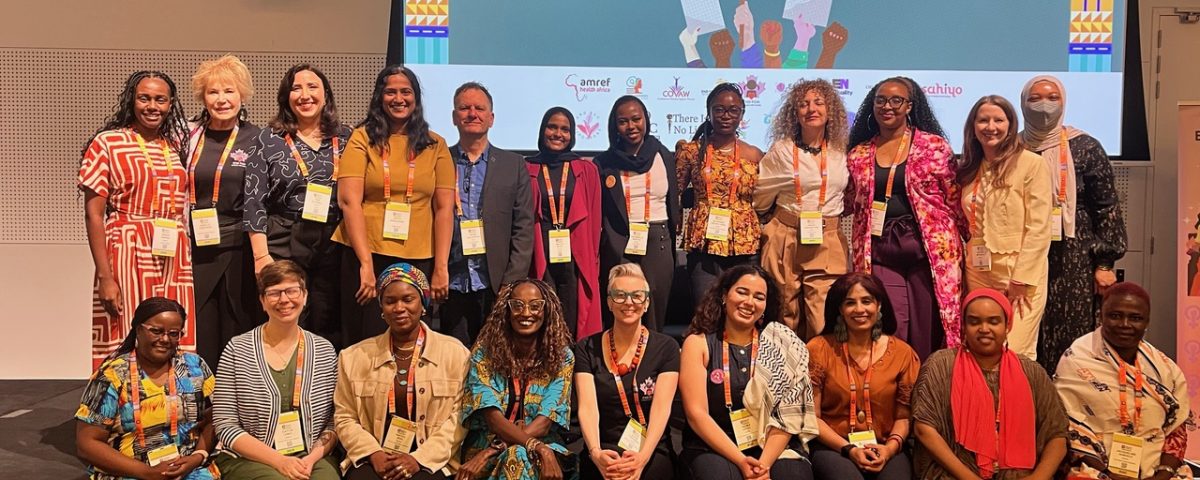
Sean Callaghan (second row, fifth from left) at the Women Deliver conference in Melbourne.
5/20/2026
By Sean Callaghan, AHA Foundation Senior Researcher
“Did you enjoy the conference?”
My usual answer is: “I don’t enjoy conferences, I endure them”.
That is my introverted researcher’s head talking. I am more at home with a spreadsheet than in a room full of strangers.
I recently returned from the conference Women Deliver in Melbourne–a room full of 6,500 strangers. But there was something important, something significant, something deeply moving, about being in a room full of unapologetic feminists at a time when misogyny is rampant, and when diversity, equity and inclusion are under attack. It was a reminder that this cause that I have given my life to is not in retreat, that I am not alone with my spreadsheets, that there are thousands of us around the world, working together to bring change.
Not everyone in Melbourne was a stranger. I was there with anti-FGM activists from around the world. Together we hosted a pre-conference and several side events. Together we reflected on the progress we have made over the past few years–even as the tide has turned against us–and of the good work that lies ahead.
“Those are not just datapoints, they are people, some of whom I count as friends and colleagues. Being together again gave me the opportunity to lift my gaze out of the spreadsheets, to once again see those statistics embodied.”
But maybe more significant–at least for me–is that we hung out together, ate meals together, danced together, laughed together. We made plans for what we might achieve together, not in formal boardroom meetings, but over breakfast and coffee and late-night drinks.
My role at the conference was to talk to the status of the global data. To bring a sense of the scale of the challenge. 230-million women and girls living with FGM. 4.5-million at risk every year across at least 94 countries.
Those are not just datapoints, they are people, some of whom I count as friends and colleagues. Being together again gave me the opportunity to lift my gaze out of the spreadsheets, to once again see those statistics embodied. To be with those who hold the pain of FGM within their bodies. To witness their courage to speak for justice. Without them this work is nothing.
“While others are focused on closing data gaps in Asia and the Middle East, we have set our focus on radically improving the quality of data in Europe and North America where it is estimated that 1.5-million women and girls are impacted by FGM. “
My role was to point to the fact that we have quality, nationally representative data for only a third of those countries, mostly in Africa. That we have extrapolated estimates of varying quality for another third, in Europe and North America. To point to the efforts of academic and NGO researchers who are working to close the data gaps in the rest of those countries, especially in Asia and the Middle East.
It is here that the efforts of AHA Foundation are significant.
While others are focused on closing data gaps in Asia and the Middle East, we have set our focus on radically improving the quality of data in Europe and North America where it is estimated that 1.5-million women and girls are impacted by FGM. Central to that effort is better understanding and modeling the impact of migration and acculturation on the risk and prevalence of FGM. That has been the focus of my PhD.
Building on that work, AHA Foundation is now investing in revising extrapolated estimates across several countries. Our initial focus is on the United States and the United Kingdom, home to half of the impacted populations in Europe and North America. After that comes Canada and the rest of Europe.
We cannot do this alone. While AHA’s supporters make our research possible, Women Deliver gave us the opportunity to dream together. To explore how we might collaborate to bring this work to their jurisdictions.