

Published: 6/30/26
By: Ayaan Hirsi Ali
In 2006, I came to America seeking a chance to build a life of freedom and safety, far from the strife and danger I saw in Europe. On this Fourth of July, I still see America as a sanctuary, but we need to be honest about the serious problems we face today.
To understand why this sanctuary is so vital, one must understand that the strife I experienced in Europe, which drove me to come to the U.S., was both personal and civilizational. In 2004, Theo van Gogh was murdered in Amsterdam. The murderer left a note for me–a fatwa listing offenses I committed in his eyes. He decreed that I, Europe, and America were to be destroyed. Unfortunately, the Dutch government dismissed Islam’s problem with them as trivial. The man was tried as a criminal, not as part of a civilizational confrontation. To me, that meant I could no longer feel safe in Europe, so I turned to America for protection. Here, in the land of the free, I found home and a new national identity, which I readily adopted.
Because of our inherited freedom, we need to push back against ideas undermining American exceptionalism. America is creative, innovative, and still free. Among the many good qualities of the American people, I appreciate their problem-solving skills and curiosity. Some Americans turn that curiosity into innovation, which, 90% of the time, means going down rabbit holes we haven’t heard of before. But every so often, someone takes an idea to the next level. I love the story of Elon Musk coming from South Africa, going to the US, and coming up with idea after idea. America is an environment that lets him grow and create the value he has. He is the giant of these creators, but many people in America do this, unlike in Europe, Australia, New Zealand, and Canada.
At the heart of this unique environment, I found the spirit of ordered liberty. I hate disorder, anarchy, and tyranny. I think we all do, those who understand what tyranny is. Ordered liberty is what the Founding documents aimed to achieve. After they were written, America developed institutions that advanced that idea. They gave the largest number of people the chance to be free, free of tyranny, and protected the market.
“You cannot weed out bad people, but you can weed out bad ideas. These toxic concepts have found many places in our institutions to root and grow, and in some places, they have successfully pushed out the original ideas. That is the challenge right now.”
America made many mistakes and failed at some things, but learned from them, too. America fought a civil war to end slavery and segregation. Other civilizations, like the Islamic, Chinese, and Russian, have not addressed their histories of slavery, segregation, repression, and atrocities. But America has, and it holds others accountable because it sees human dignity as the greatest value, which is exactly what the Founding Fathers tried to enshrine. American institutions make the promise to protect human dignity as best they can. If you don’t understand that, you don’t understand the American doctrine.
Therefore, I still see America as a sanctuary. I still think it’s the best country in the world. But we have to work harder to achieve the next 250 years. To protect our liberty and freedom, we have to focus on a threefold dilemma: moral confusion, a leadership crisis, and a deep crisis of doctrine—what I like to call a creedal crisis. This crisis has created a vacuum filled with many bad ideas, some truly bad. One of the especially toxic examples is the narrative that envy is a virtue, manifested in the cultural urge to “bring Elon Musk down.” That’s what they’ve been doing since SpaceX went public.
We have challenges and huge problems in America. Some people can’t tell right from wrong or male from female. But we also have major technological advances happening fast before our very eyes. We still have the world’s greatest military and navy, the greatest economy, and the greatest people. We have the world’s greatest story: the Declaration and the Constitution.
This modern moral confusion brings to mind what John Adams wrote in an October 11, 1798 letter, “To the Officers of the First Brigade of the Third Division of the Militia of Massachusetts.” He warned that unbridled human passions like avarice, ambition, and revenge would break the strongest cords of our Constitution as a whale goes through a net unless restrained by morality and religion. It is precisely this foundational morality and religion that are in a crisis in America right now.
“You cannot have critical thinking or problem-solving without freedom of conscience and speech. If people are afraid to think or speak, progress stops. The work we need to do in these institutions is clear—the real obstacle is fear.”
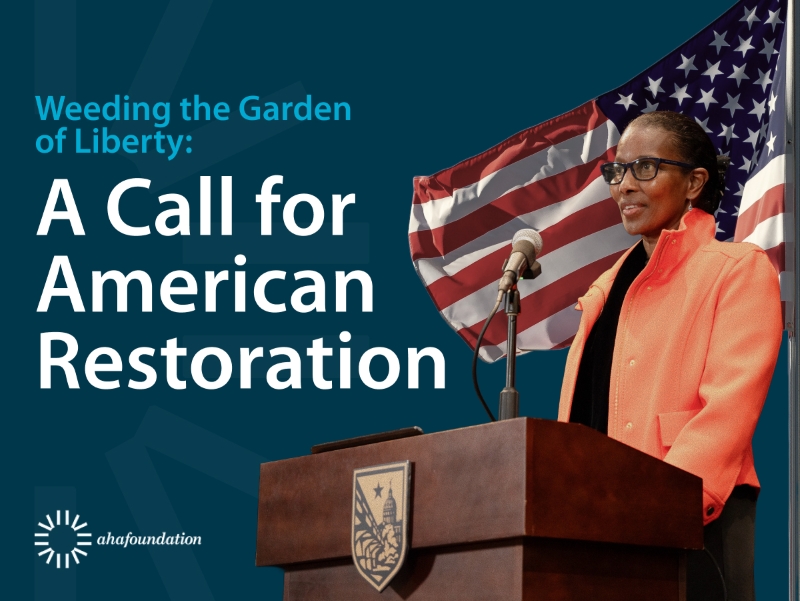
To solve these crises, recapturing our institutions and restoring what America stands for is essential. Let me use a gardening metaphor, as we are in the depths of the summer season. We dig up garden beds, cultivate them, add new soil and fertilizer, but a few days of neglect and they fill with weeds. These bad ideas are exactly like that. We have so many weeds in America now that our job is to start weeding them out. Pay attention: I am not saying weed out bad people. You cannot weed out bad people, but you can weed out bad ideas. These toxic concepts have found many places in our institutions to root and grow, and in some places, they have successfully pushed out the original ideas. That is the challenge right now.
In light of this, if I had to write new Founding Papers in the 21st century, I would not add anything new. I would dust off the existing ones and rewrite them for today. People think they can embellish or improve them, but I don’t believe we can. Our job is restoration, not invention. Unlike AI or other technologies, where we constantly seek new solutions to new problems, these foundational documents already solve our problems. The only problem left is managing human nature and ensuring we do not destroy the framework we inherited.
Concretely, this means the 21st century must be about restoring these works and recapturing our institutions. There is no alternative but to confront infiltrators, subversives, and their ideas directly. For example, after 2016, Bernie Sanders, an independent, gained a massive foothold because Hillary Clinton lost. He ushered in a wave of disciples and the bad idea of so-called democratic socialism, which is just socialism with communist traits. To recapture the Democratic Party, the task is to remove Bernie Sanders and his ideological followers from the organization.
Similarly, the Republican Party should do something similar by removing fringe actors like Nick Fuentes and those who share similar ideas. It’s about clearing out harmful concepts across the board. Universities also need to identify and remove the bad ideas that have taken hold over the past century, along with those who promote them, so students can actually learn to think for themselves.
“No one else in the world has what Americans have. That realization should inspire them, filling them with awe and with love for America…It should express itself in the active appreciation of what they have, in its preservation and protection, and in the solemn obligation to pass it on to the next generations.”
Critical thinking must once again become a priority, as it is closely tied to problem-solving. You cannot have critical thinking or problem-solving without freedom of conscience and speech. If people are afraid to think or speak, progress stops. The work we need to do in these institutions is clear—the real obstacle is fear. Many of us are afraid or distracted, and we think we have better things to do. Most people, including myself, don’t like politics. But if we let the two major parties be run by dishonest, corrupt, or incompetent people, we will inevitably end up with bad policies that waste resources and empower our enemies.
This brings us to the next generation, where young Americans are increasingly skeptical of patriotism. I would urge them to travel to other countries, examine other societies, and read the classics so that they appreciate that what they have is unique in history and geography. No one else in the world has what Americans have. That realization should inspire them, filling them with awe and with love for America. That expression of awe and love is precisely what patriotism is. It should express itself in the active appreciation of what they have, in its preservation and protection, and in the solemn obligation to pass it on to the next generations.
My final advice to them is simply to read the classics. Go to the library and start digging out the foundational texts. A great exercise for young people today would be to challenge them to even recognize these classics. While some of us take these texts for granted because we were forced to read and discuss them, Gen Z and millennials often haven’t even had that chance. Furthermore, the modern academy has tossed out the Bible and no longer recognizes it as an essential literary key to reading and understanding the classics. As a result, these young people don’t understand where our cultural expressions, idioms, and values even come from.
As a country, we Americans still have a lot to celebrate, and I hope there will definitely be lots of fireworks on the Fourth of July. But as I watch those fireworks, I will keep thinking about the foundational and moral crises that we must face to protect our country. There is only one America, and we simply cannot let it shatter, despite what our enemies would want.